Showing posts with label Film Review. Show all posts

Sunday, 5 March 2017

Adaptation Film Programme : Persepolis (2007)


Persepolis (2007) is an animation which was co-written and directed by Vincent Paronnaud and Marjane Satrapi. Paronnaud is a french comic book artist and film-maker, his other noticeable works include 'Chicken with plums' and 'Raging blues'. Born in 1970 La Rochelle. Satrapi has worked with Paronnaud in the more recent film 'Chicken with plums'. Born in 1969 in Iran, she is a graphic novelist and a children's book author. Her novel 'Persepolis' (2000) was later adapted onscreen several years later.

Set in 1970's Iran, the film follows the autobiography of Marjane Satrapi. Her harsh child-hood and most of her adult life being subject to the tyranny of Islamic fundamentalists. Everything is censored to some sort of degree and the people are not safe even from their own government. Satrapi is sent away to Vienna to start a-new and away from the bleak cruelty of her homeland.

This film touches upon the fragile subject of the Iran plight of governments and the re-precussions of their proceedings on their own people. Crushing the freedom of speech and the will of individuality. I would recommend this film to those seeking to gain knowledge of this time through the eyes of one instead of many. If you have seen 'Waltz with Bashir' I would infer this would help construct an even more in-depth look upon Islamic culture.

Adaptation & Professional Practice Film Review - Waltz With Bashir (2008)

Israeli film maker Ari Foleman wrote, directed and stars in the autobiographic animated film 'Waltz With Bashir' (2008). It follows the 1982 invasion of Lebanon and the animation recreates events told by soldiers re-collecting the event to someone who has had a lapse in memory in regards to the war. It won Golden Globe Award for Best Foreign Language Film, an NSFC Award for Best Film and other prestigious awards.

The film begins with an old associate of a Ari Foleman getting into contact with him over a very perculair dream, one that is described to be fabricated from an experience his contact had in the war. From this recreation it drives Foleman's obsession to discover his memories and understand the strange dream he is also having.

From start to finish the animation is crisp, clear and the animators make sense of the conversion from 2d to 3d. It is presented rather clever, even the transitions from animation to existing camera footage is seemingless and doesn't interrupt the feel of the film. I would recommend this film to people who would be interested to learn a different interpretation towards the war against Palestinians from a soldiers perspective view, also those who prefer animations to be presented in a 'Walking Dead Graphic Novelist Style'

Monday, 6 February 2017

Sita Sings The Blues Review - Adaptation Film Screening

Fig.1

Sita Sings The Blues (2008) was an independent project that was written, produced and directed by american illustrator Nina Paley. It was her very first feature film so she took much pride and consideration into her work, taking 5 years to complete the film. The film has hailed several awards which includes Best Animated Feature at Ottawa International Animation Festival and a Special Prize  at the MONSTRA festival. The film is free to all and was released to download in early 2009.

The film itself was divided into two, with one half being the explanation behind the Sanskrit poem Ramayana. The prince of a prestigious kingdom is exiled to the wilderness with his devoted wife Sita. They survive 14 years in the wilds away from society. The second half is related to Paley's own experience with love, her husband was offered a short contract abroad in india and ever since travelling over there they have grown distant from one another. Nina has incorporated an old poem to relate to her own experiences on the matter.

Fig.2

From the transitions between each section there are three illustrated motifs that share their own opinion on the story of Sita. They bring humour into the equation by contradicting the story and giving both modern and contemporary views on the relationships between the characters. The film has both eastern and western influences running throughout, the Bollywood styled dancing and musical sections bring the film back to the Ramayana poem with style and looks to captivate a wider audience than most influenced animations. Overall I recommend this film to people who are interested behind some of india's culture and teachings and those who watch animations with a lighter tone.

Illustration List

Fig.1 Sita sings the blues (poster) At: https://upload.wikimedia.org/wikipedia/commons/thumb/f/fe/Sita_STB_Poster.jpg/220px-Sita_STB_Poster.jpg accessed on 5.02.17

Fig.2 The talking illustrations (ad) At: http://ep.yimg.com/ca/I/yhst-20024741711964_2257_11763326 accessed on 5.02.17

Tuesday, 31 January 2017

Spirited Away Review - Adaptation Film Screening

Fig 1. Spirited Away Theatrical Release Poster

A heavy hitter in the feature length anime film industry, 'Spirited Away' created by Studio Ghibli's Hiyao Miyazaki, is an adventure of boundless imagination, surrealism in anime form and until recently the highest grossing anime film of all time. It is a Japanese film at its core of course, and its animation style is the flux of 2D and 3D designs into one swift movement. It is another one of Studio Ghibli's successes in the competition, a production company that has a vast catalog of awe inspiring content; from 'Castle in the sky' to 'When Marnie was there'. 
Fig 2. The Bridge

It is the story of a ten-year-old girl named Chihro, on the way to her new home, her family visit a strange and mysterious tunnel that leads to a secret world filled with bizarre wonders. Her parents undergo a transformation and Chihiro must fend for herself as she learns to live beside spirits and all manners of strange creatures. Her quest is simple, to revert the form of her parents but her path is clouded with uncertainty and danger.

The animation produced for the audience is undeniably painstaking to complete, usually there is a tendency to simplify certain visuals to ease the burden. But the studio's efforts offer the audience complexity. The background is filled with intricate workings and the animation works to make the film fluid instead of being trapped within a frame. The scenes are created frame by frame and the use of computers was deployed to help with the workload. Miyazaki began his career in this artstyle, he works in key with realism and has personally commissioned thousands of frames by hand.  

Spirited Away is as already stated a japanese animation and I would say the elements that help anchor the anime to its home ground would have to be the designs of the bath house, the kimono dresses the cleaners deploy and the assortment of clothing and fabric designs. 

Image List
Figure 1. Spirited Away Theatrical Release Poster, accessed at https://www.google.co.uk/imgres?imgurl=http://t1.gstatic.com/images%3Fq%3Dtbn:ANd9GcS6MveoDoJOg9-wMvtHE4ak_-HDZeYS1egb9PwRcf8lhrtcppMc&imgrefurl=http://t1.gstatic.com/images%3Fq%3Dtbn:ANd9GcS6MveoDoJOg9-wMvtHE4ak_-HDZeYS1egb9PwRcf8lhrtcppMc&h=570&w=380&tbnid=dfuH6uYYG6MOqM:&vet=1&tbnh=186&tbnw=124&docid=7miG33z-M1YmHM&itg=1&usg=__PqR3itISOiihWBVzv2P1HoGZb8I=&sa=X&ved=0ahUKEwj60-TjvOzRAhWLA8AKHRPiAFYQ_B0IhgEwCg&ei=KY-QWLqbF4uHgAaTxIOwBQ on 31.01.17

Figure 2. The Bridge, accessed at https://stillsfrmfilms.files.wordpress.com/2013/05/031.jpg on 31.01.17

Max & Mary Review - Adaptation Film Screenings

Max and Mary (2009) is an Australian animation directed by Adam Elliot. Starring the voices of Toni Collette as Mary Daisy Dinkle and Phillip Seymour Hoffman as Max Jerry Horovitz. It is a drama comedy from Australia that manages to be sickly-cute, alarmingly grotesque, and right-on at the same time – often in the very same scene. The animation is a stop animation mould, the creators move the characters and set pieces slightly in each photo frame to illustrate movement in a still world. It is actually based on a true story , the director had a pen-friend with the Asperger's condition. The animation is a adaptation of this fact.

In a brief synopsis, Max and Mary (2009) follows the friendship of two pen-friends whose fates intertwine by pure coincidence, they look to learn more about the world from each other conquering themselves in the process. Set firstly in the mid 1970's, the story spans over 20 years of their friendship. Their ups and downs, agreements and disagreements, a tale of the pursuit of knowledge and loving themselves before others. The main characters as the title suggests are indeed Max and Mary, although their are a couple of other characters that feed into the story as directly.

To my belief the animation was trying to achieve an emotional response in the audience, trying to be relevant with connecting with our exterior and interior flaws. It tried to bring the bleak and uninteresting life of a middle aged New Yorker, with the life of a young intrigued girl from Australia. It did this correctly through the use of clever colour schemes so we could differentiate from the two locations, and the narration of the characters emotions to the audience. I think the animations editing was clean cut throughout, it didn't need many tear aways or transitions due to the fact the story was forever moving forward on screen. The passing of time was illustrated with a straight cut to a panel detailing the time passed from each scene to another. It is quite a disturbing film, it is quite blunt with its explanations of processes. It is both light-hearted and dark humorous. I would recommend this film to people who have seen films such as Coraline and Boxtrolls.

Friday, 13 January 2017

B Movie - Creature From the Black Lagoon (1954) Film Review


Fig. 2/ Poster

Creature from the Black Lagoon is an old 1954 horror movie directed by Jack Arnold.  He is one of the leading film-makers in the 1950’s.he has directed famous thriller movies like, It Came from Outer Space (1953) and. Tarantula (1955). This film is about a group of scientists in a jungle in search of an undiscovered animal, after finding its residuals in a jungle.

The purpose of this particular review is to analyse elements of the films and discuss what actually makes this to be a B-Movie and positive key points that makes the film still be prominent. This film was supposedly filmed in 3D and the director used the polarized light method. The whole story is about an underwater monster killing everyone who is trying catch him and disturbing his natural habitat and of course falling in love with a girl. The monster is none other than a man in a suit and holding his breath under water for 4 min. Nothing is really horrific about it except the monster suit itself. Another thing that seems to be quite irritating would be the part when the music plays repeatedly when the monster appears. This film does have certain flaws here and there but that makes it a B-Movie, which also includes poor acting.


                                         Fig. 2 ( Sea Monster)

However, contrarily the film is has done amazingly in many other ways. We are dealing with a Fish man in this film and something that hasn’t been discovered by anyone. A great place to shoot this film would be a jungle and there is nothing better than the Amazon. The environment educes this kind of feeling of going back in time and attempting to see the world before humanity set foot. 
Another aspect that seems to be enlightening is the underwater sequences; they are shot beautifully. The creature being able to explore and able to hide behind sea plants when intruders and only attack them after it feels confident enough.

Overall, it is a great film that has caught many audience attention and still stands to be one of the greatest B-Movies made in history.


Illustration List

(Accessed on: 02.01.2017)

Arnold, J (1954) Figure 2. Sea Monster 
(Accessed on: 02.01.2017

Exploitation Cinema - Mad Max Fury Road (2015) Film Review

Fig. 1 Movie Poster
Fury Road is part of the Mad Max series and presents itself in this fantastic feature. Set in a post-apocalyptic environment where the earth has turned to ''dust'' as it were, we meet Max who is a character with clear inner-struggles that is constantly hovering the line between sanity and utter madness. Miller presents the world with cars and other means of transportation to be worshipped and human life to have no value. There is disease, poverty and water supplies are kept private as a means to control the population.

Although the title may suggest that Max is the main character, however the alpha in this film are the females. Namingly a woman called Furiosa, and as Robbie Collin writes, ''Furiosa is one of the toughest, most resilient action heroes in years, with a metal prosthetic arm that hints at past trauma and a steely gaze that sees more on the way. Like Sigourney Weaver's Ripley in the Alien films, the character is informed by her sex but not defined by it, and Theron superbly embodies her stoicism, nerve and resolve.'' (R. Collin. 2015). She is clearly one not to mess with and along with her we have the wives of Immortal Joe. Beautiful women and the perfect symbol of purity and beauty. These females are what start this who chase-orientated movie. As they don't appreciate being used as cattle for Immortal Joe's needs. They want to escape and Furisoa takes them away in a giant war-rig. (see Fig.2)
Fig. 2 
A beautiful piece of machinery that houses gallons of water and ''mothers-milk''. The idea is that Furisoa takes them to a pass and trades a pod of petrol for safe passage, but as they escape they procure and entourage of vehicles from the three factions - the bullet farm, the men from Gas town alongside Immortal Joe from the citadel.

Aside from the mass chase theme and the dust, dirt and explosions the plot is simply structured and without really understanding the rest of the series you don't really get to lost. It's a brilliant example of well placed camera work, great CGI and great acting all round. I witness this with a silver sprayed smile.


Image List:
Miller, G (2015) Figure 1. Mad Max Fury Road Poster. http://www.opoderosoresumao.com/wp-content/uploads/2015/08/10320615_1420333831604515_2358485737340164025_n_by_punmagneto-d8osh18.jpg.
Miller, G (2015) Figure 2. Mad Max War Rig http://madmax.wikia.com/wiki/File:Fury_Road_WarRig_001.jpg

Comedy - Shaun Of The Dead (2004) Film Review


Fig. 1. Shaun of the Dead poster.

Shaun of the Dead (2004) is a comedy, horror film directed by Edgar Wright, who has directed other great comedy’s such as Scott Pilgrim vs. the World, Hot Fuss and The Worlds End. The film is almost a parody of the zombie genre and it gains its laughs from the use of violence, some jokes that it sets up early on and the simple minded characters.

The story is about the very average guy Shaun (Simon Pegg) and his failure of a life, it starts off with Shaun having a terrible day in which everything goes wrong, he attempts to turn his life around and win back his now ex-girlfriend, but unfortunately for him the day he attempts to change is the day a zombie apocalypse breaks out. Shaun however sees this as a chance to prove to everyone he can be useful, he just has to survive and of course win his ex-girlfriend back.

It could be argued that Shaun of the Dead is essentially a slapstick comedy as a lot of the laughs come from inflicting pain on the zombies or each other, the gag in which Shaun attempts to jump over a fence and it falls over is repeated in other films that Wright directed and has become an expected joke that gets funnier every time. In Shaun of the Dead it comes at a moment in which Shaun is attempting to appear strong and in control, which makes the gag that much funnier.


Fig. 2. Couch Scene

The film is also a great parody of the zombie genre and in fact our culture in general, it starts off by showing everyone looking and walking like zombies although the apocalypse hasn’t started yet. It shows people walking around staring at their phones and dragging their feet, ironically this means that when the apocalypse actually happens it’s hard to tell that zombies are actually among them, which is funny to observe. This means that when Shaun and Ed first see a zombie in their garden they assume that she’s just drunk, by accident Shaun causes her to fall and impale herself on a parasol base, when she gets back up they then realise she is a zombie. A funny scene follows in which they attempt to kill two zombies by throwing vinyl records at them, as Ed pulls them out and throws them Shaun complains that some of this collection is rare. So as two zombies slowly approach them with the intention to eat them, they search through the collection looking for vinyl’s that aren’t that valuable.

Another great scene is when they attempt to get into the Winchester pub for safety, they are surrounded by zombies and they are pretending to be zombies to not cause any suspicion. Ed’s phone rings and he casually tells the group he needs two seconds and answers the phone, discussing with someone that was looking to buy some weed. Obviously this alerts all the zombies that they are in fact human and that they should be devouring them, the stupidity draws out a chuckle as most of the things Ed does are idiotic.

To conclude Shaun of the Dead is a film that draws most of its human from violence like slapstick comedy, it is ultimately a parody of zombie films and attempts to make the genre into a funny experience instead of the usual scary, hiding behind a blanket kind of experience. The gags that continue throughout other films almost feel rewarding every time you see them as you are in on the joke and it aids in finding them that much funnier. The laughs also come from how mundane they make zombie fighting appear, as they always have something more important to be discussing like getting back together or which vinyl can be thrown.


Illustration List:
Figure 1: Shaun of the Dead Theatrical Release Poster, At https://i.yomyomf.com/wp-content/uploads/2012/01/Shaun-of-the-Dead-poster.jpg Accessed on 2.01.2017
Figure 2: Shaun and Ed, At http://s169.photobucket.com/user/ppcccaps/media/shaunofthedead4.jpg.html Accessed on 2.01.2017

Monday, 14 November 2016

Opposing Characters - Batman vs Superman (2016) Review

 
Figure 1 - Batman vs Superman Theatrical Poster
 
Captioned the greatest superhero match up of our generation, Batman Vs Superman Dawn of Justice (2016) is a film that brings both characters to a single film as they bout for the victor. The audience has a subtle hint to the outcome through graphic novels and story arcs from the past of the DC universe that Warner Brothers brought to life onscreen. The society in this film believe there should be no Superman because of his alien like actions and Batman is the one who agrees and will also take Superman down. While Superman fears that Batman's actions are wreckless and fearing others. Meanwhile behind the scenes of this conflict, Lex Luthor is plotting something that will destroy mankind. This is what ultimately would pull the two unlikely allies together to face a common foe and save humanity. "Snyder has brought a different edge to the superhero genre, one that questions what drives these men of steel and creatures of the night to do what they do and believe what they believe. There is something to admire in that." (Pejkovic,M)
 
In this review I will be focusing on the opposition to these main characters. What really drives a wedge between their own personal outlooks of the world they both reside in and if any similarities may rise to highlight them. This will be done by reiterating the use of binary oppositions and applying that concept into film.
 
 Figure 2 - Batman
 
Batman is the assumed persona of Bruce Wayne (Ben Affleck), an orphaned Billionaire and heir to Wanye industries and a massive fortune. Left without parents from the actions one fateful night, he was forever scarred by the incident and never found resolution. Born and raised in Gotham City, he was taught to care for the people of this degrading city and the Waynes were a part of that society that sought to fix what was broken. So for Bruce to lose his family to what they attempted to amend was unacceptable and he grew dark and disconnected. His fear was Bats and for him to don that as a symbol was a mastery of fear and he wanted to impose that print on those whose wrongdoings affected the innocents. His journey throughout the film is a development of his views toward alien visitors and their dominance to what man can achieve. From not being to trust Superman is here to save humanity, to coming to common ground with an individual that is, like him driven to save others. A scene that captures this change is when Batman is about to take out Superman with a Kryptonite spear. "Why did you say that name? Martha? Why did you say that name? WHY DID YOU SAY THAT NAME?" (Batman), at this pinnacle point Batman then begins to realize that Superman has undergone a similar origin to him where their families sought to protect and were wronged, that they would do anything to accomplish the task of saving others from that fate.
 
Figure 3 - Superman
 
Superman is the mantle that Kal-El (Henry Cavill) son of krypton possesses. Sent to earth in a pod while the rest of his race is torn apart from its own planets mass, he is an orphan to not just a family but to an entire race. Raised by Martha and Jonathon Kent on a farm in Kansas, Kal-El is given the name Clark Kent and is shielded from everyone and his abilities kept secret, in fear of what people would think. He then leaves the farm after the passing of his father and goes on a journey of discovery to learn the roots to his origin.
 
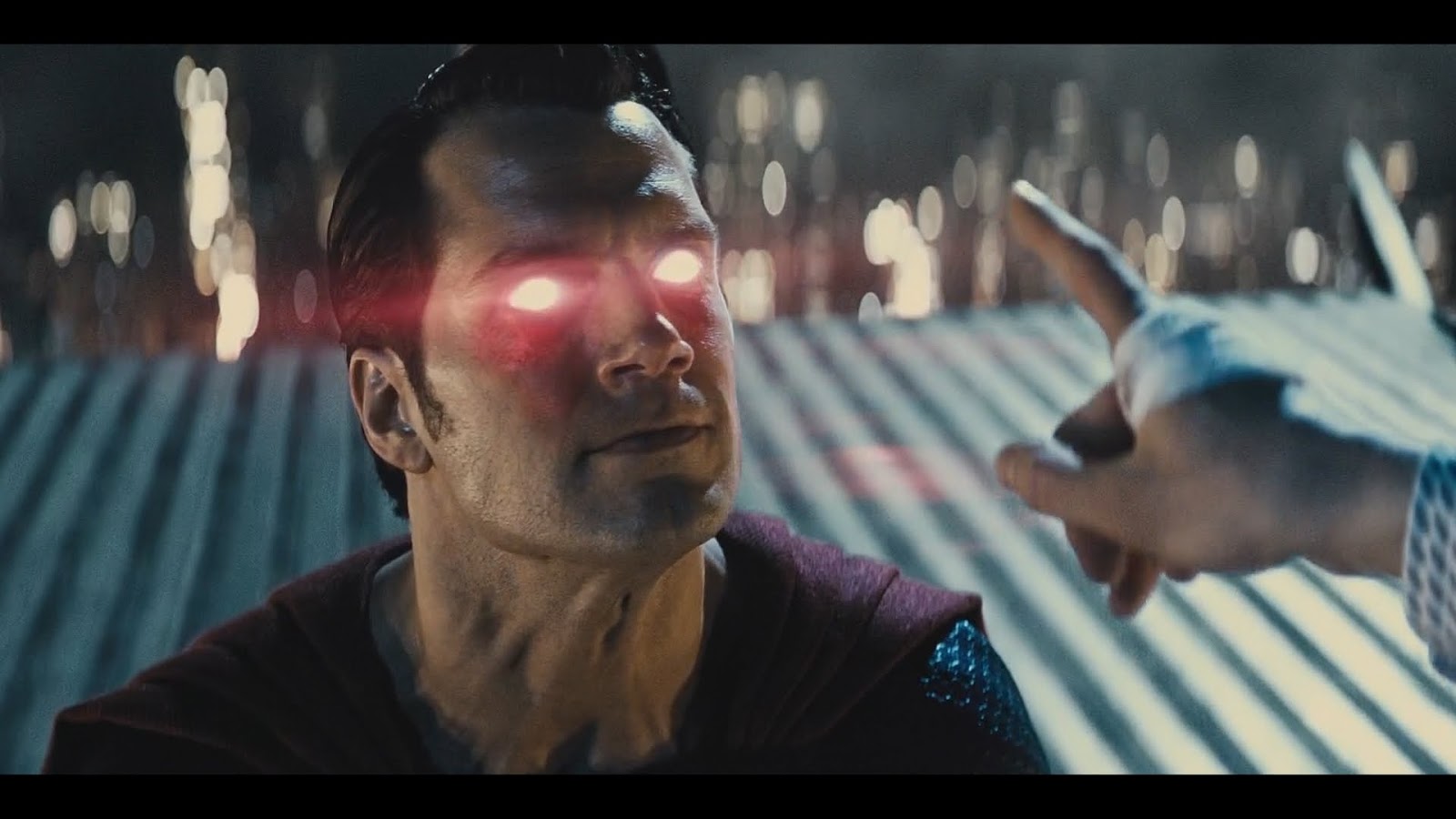
In this film which is a direct continuation of that journey, Now known to the world as Superman 'A beacon of hope' he now has the attention of the planet on his shoulders and is asked the question why does a man dressed in a Batsuit go unopposed while there is a man capable of godlike feats around? Superman's journey throughout the film is not being able to accept that a man who is clearly conflicted mentally should govern crime to his choosing unchallenged. There is a scene that perfectly shows his acceptance to the concept though, and that at this particular point of the film Superman no longer cares about his conflict with the Batman, but instead to save his human mother, Martha.
 

Figure 4 - Superman & Lex Luthor
 
Pictured above (Figure 4) is the confrontation between Superman and Lex Luthor, Lex learns of the truth behind the man of steel and has unmasked him. Taken his mother from him as a hostage and has pitted Superman to travel to Gotham where the Batman is waiting for a bout to the death. Superman for a moment is unhinged and is about to incinerate Lex which is a move that would stun and shock audiences of the cult fiction. Its a move that Superman would never do. Its this sense of desperation and outrage that gives Superman an incite to how Batman operates, Batman is a seasoned Anti-hero who has policed a city long enough to realize that cleansing is better than rehabilitating. 


 Bilbography List

Batman (2016) Batman Vs Superman. Accessed at http://www.imdb.com/title/tt2975590/quotes on 14.11.16
 
 
Illustration List


Narrative Structure - Star Trek Into Darkness (2013) Review

Figure 1 - Star Trek Into Darkness Theatrical Poster

Directed by J.J.Abrams and the sequel to the 2009 revitalisation of the iconic series. 'Star Trek Into Darkness' (Figure 1) is the introduction to one of most proclaimed villains in the franchise and Abrams next step to boldly reimagining the series. After the crew of the Enterprise find an unstoppable force of terror from within their own organization, Captain Kirk played by 'Chris Pine' leads a manhunt to a war-zone world to capture a one-man weapon of mass destruction.

In this review we will be focusing upon the Narrative Structure of the film and whether the film fits with the three act structure I feel it can be dissected into. Following Gustav Freytag's Pyramid of Structure.
Figure 2 - Freytag's Pyramid
 
 
Before beginning our investigation into Narrative Structure within this film selection, it would be applicable to mention the Freytag theorem. Pictured above (Figure 2) is a demonstration of Gustav Freytag's theory behind structure. Behind every story there is an inciting incident and need for some sort of action, follows through the same lines as a prologue. It expresses the need toward a resolution of the situation. This introduces the concept of the three act structure within film, the Exposition, the Climax and the Denouement. There are of course rising and falling actions in there aswell to consider but we will now apply this knowledge to our review.
 
 
Figure 3 - Captain Kirk
 
Act 1
 
We are introduced to Captain Kirk and the crew of the Enterprise as they are attempting a planetary wide rescue by interrupting an active volcanoes wrath and violating the Prime Directive. "Do you know what a pain you are? You think the rules don't apply to you. There's greatness in you, but there's not an ounce of humility. You think that you can't make mistakes, but there's going to come a moment when you realize you're wrong about that, and you're going to get yourself and everyone under your command killed."(Pike, C) Kirk is soon after grounded and de-ranked as the results of his efforts to save the planet and his First Officer. Kirk feels the need to express his maturity to Starfleet by once again going under the Wing of his superior Admiral Christopher Pike. This is included to show the audience that whatever is going to take place following the actions of the prologue will be a redemption of not the crew of the Enterprise entirely, but by Captain Kirk himself and his actions critiqued by his subjects. His legacy.


 Figure 4 - Khan Noonien Singh
 
It is also in the First Act we are introduced to Khan Noonien Singh.(Figure 4) The main anti-protagonist of the film. Someone who is represented to be manipulative and a devious man, someone crafted to be the man that Captain Kirk must overcome to have resolution in not just the story but for himself. Khan Noonien Singh kills leaders of Starfleet and is a wanted fugitive for his actions under the false pretence of 'John Harrison'. This is what drives the act and brings Captain Kirk to the first step of his redemption. Piloting the Enterprise to pursue and capture the fugitive and bring him to swift justice. "That being said, Khan Noonien Singh is the most dangerous adversary the Enterprise ever faced. He is brilliant, ruthless and he will not hesitate to kill every single one of you." (Spock,A). With the audience armed with this narrative the structure continues into Act 2.
 
Act 2

Captain Kirk is emotionally compromised by the events that took place when Khan decimated Starfleet command and seeks to bring him to justice for the heinous crime that has been committed. But he is ordered by Admiral Marcus (Figure 5) to deploy torpedoes onto his position in orbit. An action that would probably end in the beginning of a new war between Starfleet and the Klingons. Instead of listening to his orders. Kirk chooses to capture the fugitive and bring him aboard for questioning. Disobeying a direct order from a superior in the process.

Figure 5 - Admiral Marcus
 
Captain Kirk learns from Khan Noonien Singh that everything to that point had been orchestrated to escalate the tension between two societies that would end in all out war. The Enterprise sabotaged and stranded on the edge of Klingon Space armed with to the brim with warheads. This is also the point where the film meets its unexpected climax in being that Khan is no longer the main threat, but it is now the chain of command that kirk himself follows. "The Midpoint, that link in the chain of dramatic action that connects the first half of Act II with the second half of Act II, is what moves the action forward and creates a new dramatic subtext.” (Field,S). This quote strengthens that the actions displayed in this Act is crucial to come to a climax that fuels the audiences need for resolution in the piece. Using the subject matter as an example, the conflict now resides between Kirk and Marcus who both have different views on what is best for those who follow beneath them. An iconic Kings of the chessboard approach.
 
Act 3
 
Captain Kirk's Journey through the film is displayed as showing trust in others and letting them take the risks he himself should have undertaken. In a classic reenactment of the franchise's lore, Captain Kirk re-aligns the warp field that would have traditionally have been a job for Spock to accomplish, sacrificing himself for the crew.

Figure 6 - Captain Kirk's Death
 
In his death (Figure 6), Kirk pushes the story into the Final Act. How his legacy will affect those beneath his chain of command. Spock is filled with rage and chases after Khan after all if it wasn't for his actions that led to the death of his friend, Spock wouldn't feel helpless and lost from his emotionless persona of Vulcan heritage. Initially Spock doesn't try to apprehend Khan but instead kill the man responsible for his pain, it isn't until after the Doctor of the Enterprise realizes that Khan is the answer to reviving the Captain. It is this resolution that compels the audience to shout "Don't do it!" as Spock throttles Khan by the neck as we know that Khan's blood is what can save the Captain.
 
Ultimately the resolution is the trust in the Captain being re-rooted in the crew of the Enterprise and the Captain to be aware of the constant scrutinizing that is done by those beneath his command and how he is looked up to. The films journey from turning Kirk from rebellious and unhinged, to coordinated with his crew and resolved in the knowledge that he joined Starfleet to help others than to fuel his own ego.
  
Bibliography List

Pike, C (2013) Star Trek Into Darkness at http://www.imdb.com/title/tt1408101/trivia?tab=qt&ref_=tt_trv_qu Accessed on 14.11.16

Spock, A (2013) Star Trek Into Darkness at http://www.imdb.com/title/tt1408101/trivia?tab=qt&ref_=tt_trv_qu Accessed on 14.11.16
 
Field, S (1994) Four Screenplays, Bantam Doubleday Dell Publishing Group 

Illustration List